
Two-pass analysis
The analysis works with structured drafts per node. Ambiguous causes can be handled as separate scenarios so they can be reviewed and rated individually.
IEC 61882
Platform
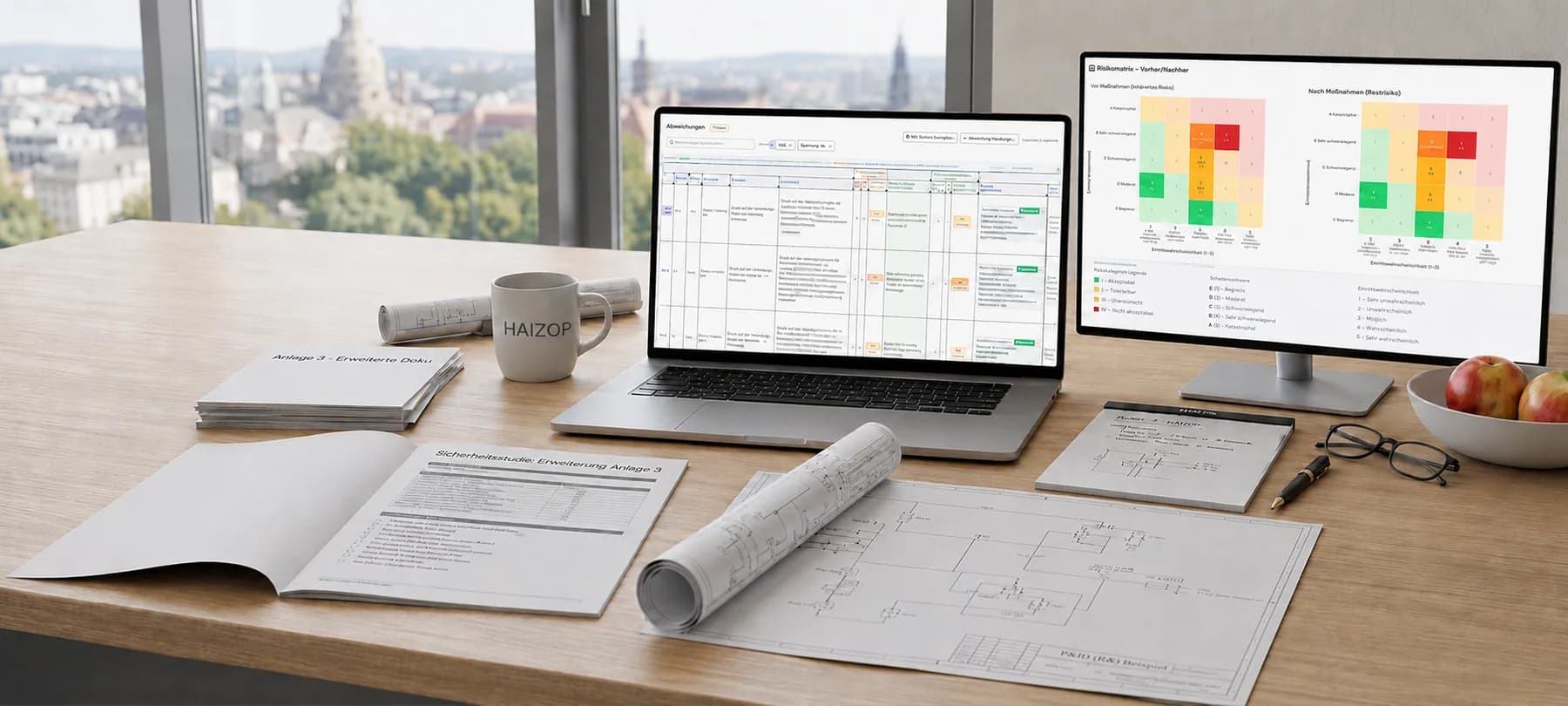
HAIZOP supports the path from plant context to reviewed HAZOP table: capture P&ID/DEXPI data, prepare suggestions, review professionally, document decisions and export reports.
[ 00 ] Product
Not consulting only
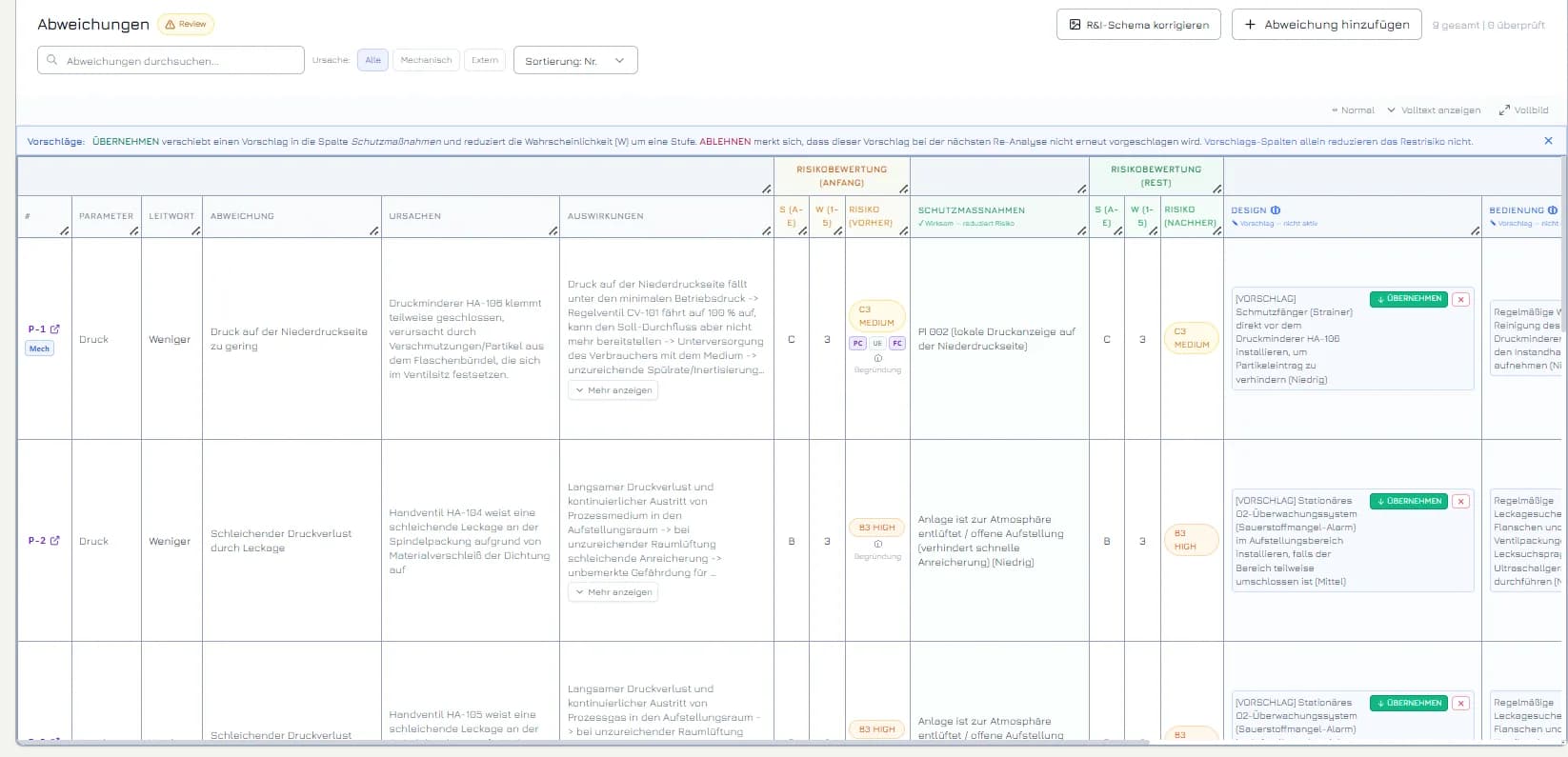
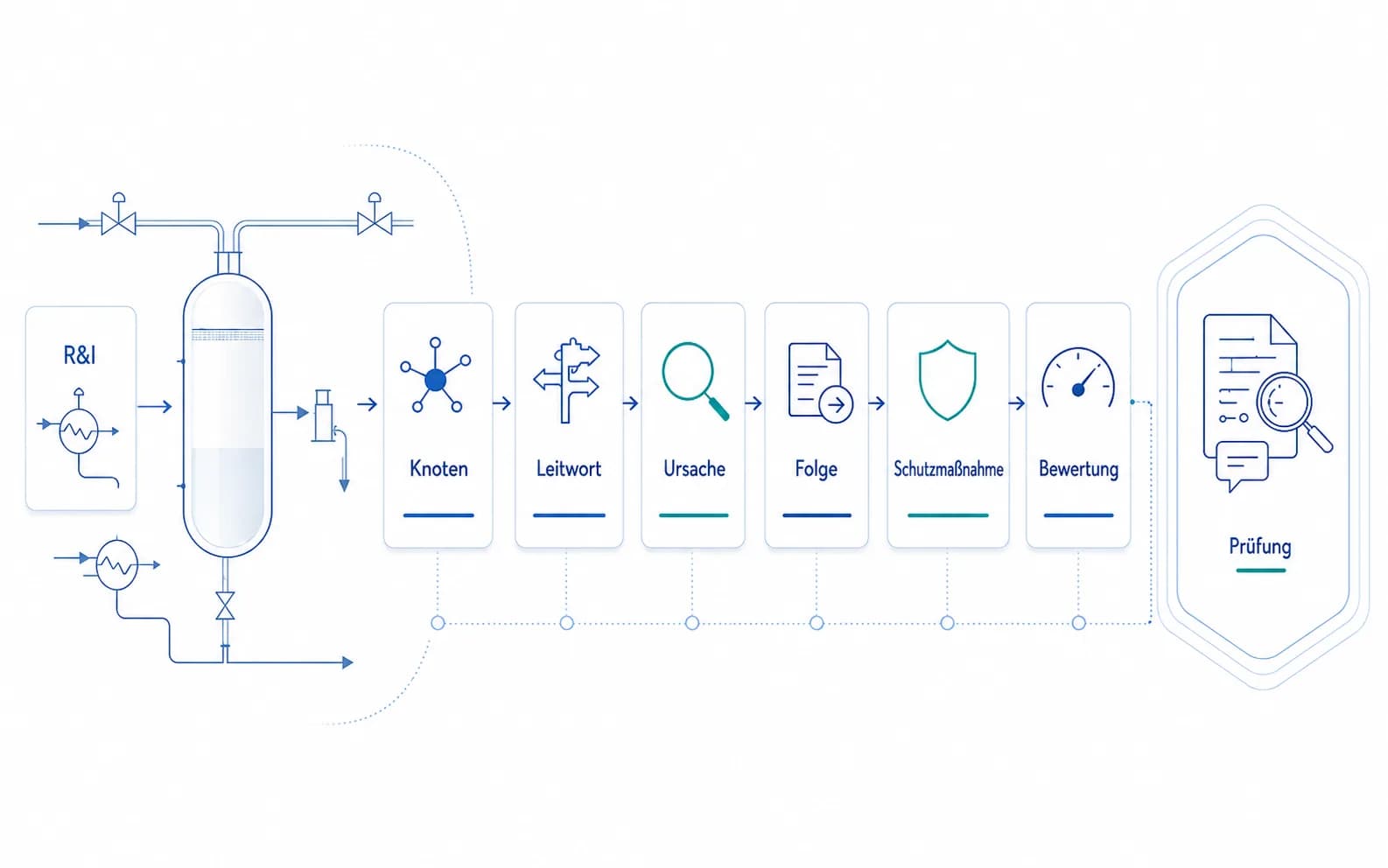
The workspace moves from HAZOP nodes through guide words, causes, consequences, safeguards and risk ranking to recommendations and report export. Workshop knowledge becomes a reviewable data set.
[ 00B ] Process logic
Technical assistance, not theatre
HAIZOP does not only read text rows. The analysis follows nodes, equipment connections and guide words, separates causes from consequences and carries expert review through to risk ranking and recommendations.
[ 00C ] Review gate
Expert-in-the-loop AI
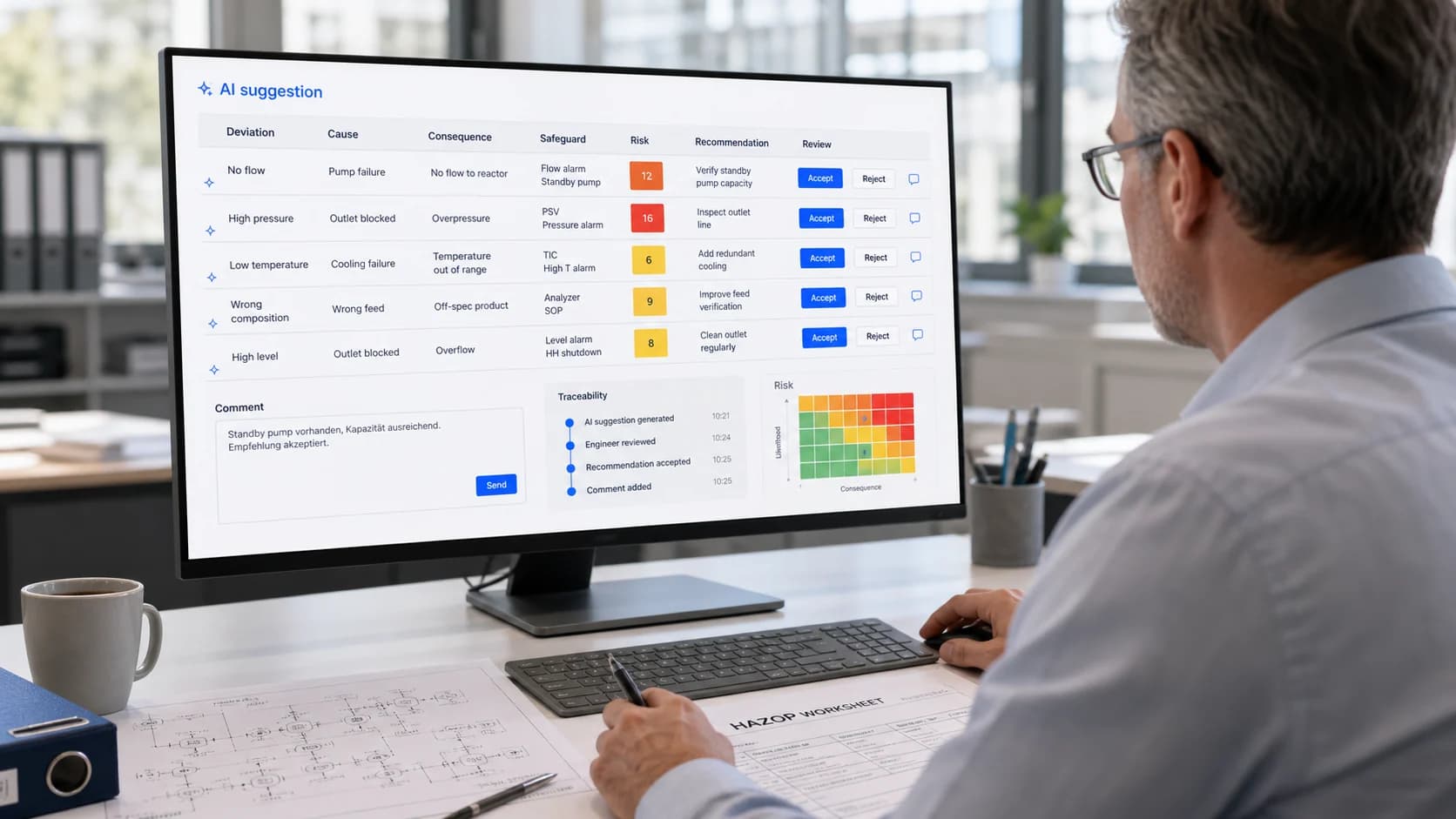
HAIZOP presents deviations, causes, consequences, safeguards, risk and recommendation as a suggestion. The expert accepts, rejects or comments - and the audit trail records what was decided.
[ 01 ] AI analysis
Reviewable, not magical
The analysis works with structured drafts per node. Ambiguous causes can be handled as separate scenarios so they can be reviewed and rated individually.
Equipment types, failure modes, detection methods, typical consequences and safeguards give the analysis practical context — especially for hydrogen and PtX applications.
Where suitable foundations exist, HAIZOP shows professional assumptions, equipment context and standards cues with the suggestion — with context rather than blanket claims.
The consequence is first assessed without the safeguard, only then with it. Counting the safeguard too early systematically underestimates risk — HAIZOP enforces the clean separation.
Context, status, source cues, consistency hints and comment fields help the team review suggestions traceably.
No auto-commit. Every suggestion waits for confirmation, correction or rejection. Export is only possible once an engineer has reviewed the results.
[ 02 ] P&ID
Machine-readable DEXPI XML is parsed; the platform creates the HAZOP nodes automatically and uses the P&ID topology as a graph — deviations follow the actual equipment connections.
Scanned CAD drawings, image PDFs and manual photos: area selection on the drawing, AI detection of components and tags. Even old or convoluted source material becomes usable.
[ 03 ] Method links
One data model, further reviews
Safety-related assessments can be prepared on the same study data where the methodology, assumptions and approval are professionally reviewed within the project.
Information on protection layers, demand rates and target values can be reused as typed fields. HAIZOP does not replace professional SIL or LOPA approval.
Failure mode and effects analysis with S/O/D rating and RPN — with equipment context as a starting point.
Cause-barrier-consequence diagrams. The HAZOP data becomes a visual hazard-barrier map.
Change requests with a status workflow and links to the HAZOP nodes that need expert re-assessment.
OT/IT threat assessment for PLC, DCS, SCADA, HMI and SIS — the safety view beyond pure process engineering.
[ 04 ] Export & report
Professional export as PDF, DOCX and XLSX — title page, methodology, node-by-node findings, risk statistics. Bilingual.
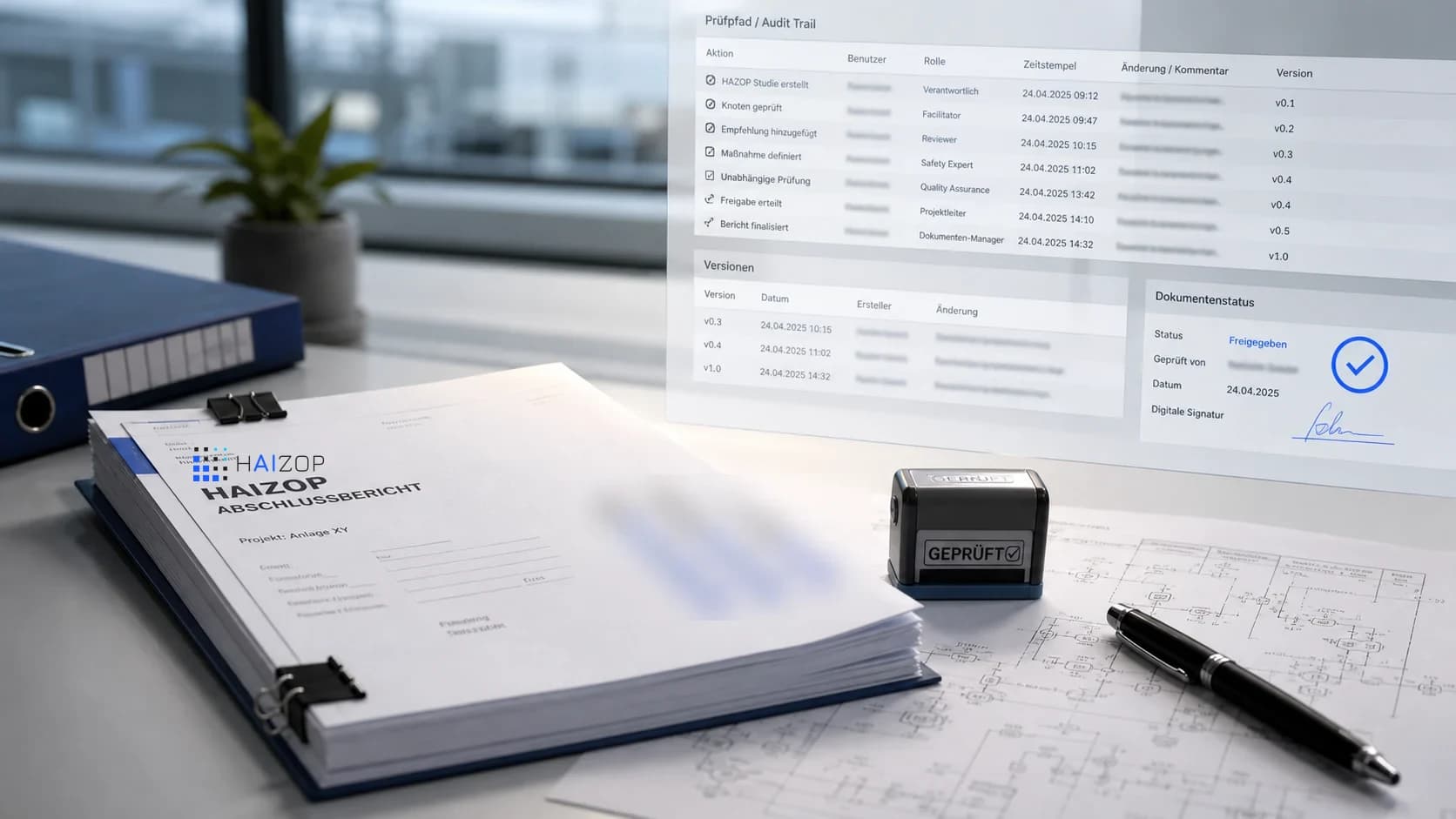
One overview for internal reviews and external auditors: version status, approval chain, risk distribution, action-item status and audit trail.
Relevant changes are logged with user, IP, timestamp and old/new value. Steps remain reconstructable later.
[ 04B ] Compliance / audit
Reviewable documentation
Approvals remain visible: version, role, timestamp, comment, approval note, report hash and report export. The HAZOP study becomes a traceable audit package for internal reviews, inspectors and customers.
[ 05 ] Questions
The AI prepares deviations, causes, consequences and safeguards as drafts. The report is only released once an engineer has reviewed the results — the review gate is mandatory. HAIZOP structures the preparation, not the responsibility.
HAIZOP reduces risk through structured inputs, plant context, source cues, consistency hints and a mandatory review gate. AI suggestions remain drafts until an engineer has reviewed them.
Machine-readable DEXPI XML with automatic node creation, plus scanned CAD drawings, image PDFs and manual photos via P&ID image analysis.
HAZOP remains the methodological core. Connected assessments can be prepared on the same study data when they are professionally reviewed and approved in the project. HAIZOP provides structure and traceability, not automatic regulatory approval.